

Your back starts tightening the moment you leave the driveway, but the car feels “fine.” If you’ve ever adjusted the seat once and still gotten that low-back ache, the cause is usually ergonomic, not your spine getting worse on every commute. You need a seat and steering setup you can dial in fast.
Start with the driver seat height, fore-aft distance, seatback angle, and lumbar support shape, then match the headrest and steering wheel reach. Real fix is also in your foot placement, plus short breaks every 30 to 60 minutes.
Adjust the driver seat so your pelvis is supported and your lower back matches your natural curve. Set seat height to keep you upright, move the seat fore-aft until elbows are slightly bent, then set lumbar so it fills the gap at your beltline. Use a headrest at mid-head height and take a 2-minute break every 30 to 60 minutes.
How To Reduce Back Pain While Driving

Back pain while driving usually comes from a consistent mismatch between your spine and the seat, especially lumbar support, seat height, and steering reach. Your fastest diagnostic is to match where it hurts (low back vs mid-back vs hip), when it starts (immediately vs after 20 minutes), and what you were doing right before it flares (leaning forward, reaching, twisting).
Fast Self-check: What Your Pattern Is Saying (Symptom → Cause → Fix)
For a quick read, note your worst point while driving: low back, mid-back, between shoulder blades, or hip/groin. Then note timing: starts right away or only after sustained sitting. This pattern tells you where the geometry is off and which adjustment to try first.
| Symptom | Likely cause | Immediate fix to try now |
|---|---|---|
| Low back aches or feels “saggy” | Lumbar support is missing, too low, or you are slumped | Raise and center lumbar, sit back until your belt line sits naturally, then add a small lumbar cushion if the seat lacks adjustability |
| Low back pain that eases when you sit tall | Seat height is too low and encourages a slouch, or seatback is too reclined | Increase seat height slightly and bring seatback closer to upright (small changes, 2 to 3 clicks at a time) |
| Mid-back stiffness or shoulder blade tightness | Seatback angle and steering reach make you brace or round your upper back | Pull steering closer by adjusting fore-aft, keep elbows comfortable, and reduce “reaching” with the shoulders |
| Hip or outer thigh discomfort | Pedal reach and seat height push your pelvis out of neutral | Move seat forward/back until your hips stay square, then check that your knees are not forced high or too low |
| Twisting hurts one side (usually during turns or lane changes) | Mirror and steering position cause repeated trunk rotation | Use mirrors first, then straighten steering and avoid reaching across your body |
Most Common Driving Setup Culprits (Quick List)
Seat position issues are usually the biggest wins. The most common culprits are a seat that is too far from the pedals (you reach with your hips), a seat that is too low (you slide into a slump), and lumbar support that is either absent or set too low to support your natural curve.
In-car rule for the next drive: Make one change, then drive 5 to 10 minutes. If the pain doesn’t reduce, reverse that change or try the next item in the table (lumbar first for low-back patterns).
Quick warning signs: if pain is sharp, numbness spreads into an arm or leg, or you have new weakness, get medical advice before you keep adjusting. If the seat rails feel loose or the steering column adjustment does not hold position, have the vehicle checked because bad alignment can keep undoing your setup.
Common Ergonomic Causes To Rule Out
Pain often comes from predictable setup errors that force your lumbar spine to work all trip long. Seat shape, seat position, and steering reach are the biggest offenders, because they change hip angle, lumbar contact, and shoulder posture within seconds.
Seat And Lumbar Contact Issues
Unsupported lumbar support is one of the fastest ways to trigger low-back fatigue. A lumbar “bulge” that is too tall, too small, or aimed at the wrong height can push your spine into an awkward curve instead of letting it stay neutral.
In practice, drivers with a fixed lumbar panel often feel relief only in certain gears and speeds.
For example, an incorrect support height can feel fine at idle but worse once you start maintaining throttle pressure for minutes at a time.
Seat Height, Fore-aft, And Reach That Force Compensation
Seat height changes the pelvis angle, which directly affects where your lower back ends up loading. Too low tends to encourage a slouched tuck, while too high can compress the thighs and make it harder to maintain comfortable pedal contact.
Seat fore-aft position can be the hidden culprit behind “mystery” back pain because it drives reach and shoulder rounding. Seat too far forward makes you hunch to the wheel, and seat too far back makes you lean or stretch to see and steer.
| Symptom pattern | Likely setup problem | Immediate change to try |
|---|---|---|
| Soreness increases after a few miles | Seatback too upright or too far forward | Adjust fore-aft and seatback a small amount at a time |
| Back pain with rounded shoulders | Steering wheel reach forces hunch | Move wheel closer and adjust seat to keep elbows relaxed |
| Pain fades when you sit “up taller” | Seat height or lumbar contact is off | Raise or lower seat height until pelvis feels stable |
Headrest, Posture Time, And Pedal Geometry
Headrest position can alter neck tension, and neck tension often drags your upper back and then your low back through whole-body posture. If the headrest is too low or too far forward, many drivers “protect” themselves by tensing their core and stiffening the spine.
Long uninterrupted sitting in one static posture also drives pain, especially when your seat lacks enough support for micro-movements. Setups that keep you locked in place amplify this effect.
Steering Column Alignment And Seatbelt Twist
Steering wheel reach forces shoulder position, and shoulder position changes how you brace through your torso. A column that is slightly out of alignment or a wheel positioned for long-arm comfort can create steady low-back loading.
Seatbelt placement can also cause a subtle twist. Leaning to thread the belt, or a belt that sits wrong across the torso, can make your pelvis rotate each time you brake or corner.
Quick reality check: If your back pain changes immediately when you adjust seat height, fore-aft distance, or steering wheel reach, the problem is ergonomic. If pain persists even after major posture corrections, get checked for non-driving causes and have the seat tracks, padding condition, and control alignment inspected.
Set Driver Seat For Lumbar Relief
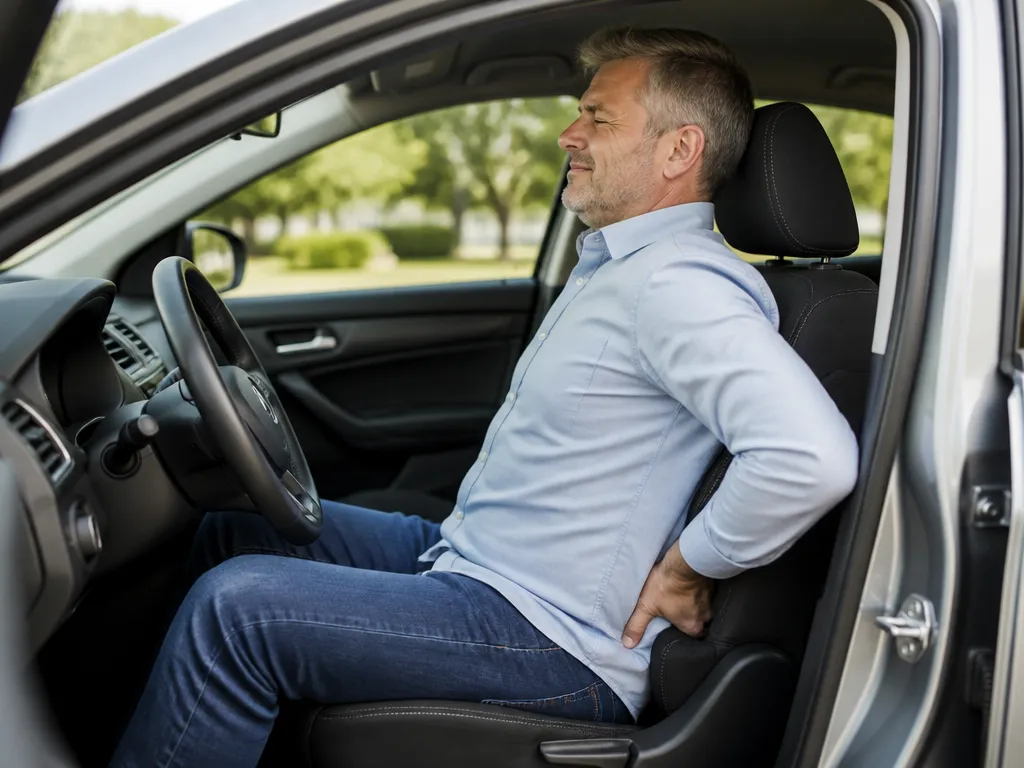
Start with the seat base so your pelvis stays in a neutral, slightly tucked position. When your knees and hips line up correctly, your low back can maintain its natural curve without you bracing or reaching.
For example, in a Honda Civic or Toyota Camry, common lumbar complaint comes from seat height set too low, which encourages the pelvis to tuck and makes the lumbar support feel like “digging” instead of “support.” Correcting height first usually makes the lumbar knob feel smoother and more effective.
| Symptom while driving | Seat setup most likely causing it | Fast correction |
|---|---|---|
| Low back aches within minutes | Seat too low or seatback too reclined | Raise seat height slightly, then bring seatback closer to upright |
| Pain increases when braking | Seat too far forward or pedal reach too long | Move seat back until knee clearance improves and hips stay back |
| Sharp pressure from lumbar knob/cushion | Lumbar is too high, too low, or too aggressive | Reduce lumbar firmness, then reposition to hit the inner low-back curve |
| Neck fatigue | Headrest too low or too far forward | Raise headrest and align it to the back of your skull |
Quick checklist (do this in under 2 minutes): hips level or slightly higher than knees, back supported with minimal effort, braking does not crowd knees, lumbar contact is even across the low-back curve, headrest supports the skull without pushing your head forward.
When something feels “off,” don’t fight it with posture alone. If your seat won’t adjust smoothly, the lumbar support doesn’t hold position, the seat rails are loose, or the steering column makes correct posture impossible, have the seat hardware inspected. Any pain that comes with numbness, weakness, or radiates down the leg is a medical check sooner rather than later.
Dial Steering Wheel Comfort Positioning
Your steering wheel setup should keep your shoulders relaxed and your torso upright, so you are not compensating with a forward hunch during turns. When you overreach, the upper back and neck take the load first, and that pain often “shows up” as low-back strain too.
Steering wheel height and angle interact with posture. A tilt that forces your wrists to cock upward usually makes you grip harder and hunch your chest, which shifts load to the back during longer drives.
Distance And Tilt Targets You Can Feel Right Now
Use these cues to get the wheel close enough for control but far enough to keep your torso stacked. If you feel yourself shrugging your shoulders, you are reaching.
| Comfort symptom | Likely steering adjustment | What to try |
|---|---|---|
| Shoulders rise toward ears | Wheel is too far away | Bring wheel closer, keep elbows soft, re-check lane-change lean |
| Wrist cocked upward at top of wheel | Tilt is off | Lower/adjust tilt so wrists stay straight while hands rest comfortably |
| Torso creeps forward to “reach” while turning | Wheel too far away or tilt forces reach | Bring wheel closer or re-angle tilt, then lock and re-test |
For cars with a telescoping or adjustable steering column, confirm the lock position. A wheel that feels like it moves even a little can encourage micro-posture changes while driving, and those changes add up over time.
Mechanic tip: After locking the column, push and pull gently on the wheel rim while seated. If you feel any play, the adjustment did not fully seat, or the column lock mechanism needs inspection.
Fix Pedal Reach And Leg Stiffness

Low-back pain often ramps up when you reach too far for the brake or clutch, or when your ankle has to stay in a tight, awkward angle. Tight leg posture makes your hips do the work instead of your seat and core, which leads to that nagging lumbar compensation. Fix the reach first, then dial in foot placement and knee angle.
Get The Pedal Geometry Right
Brake and clutch reach should let you press the pedal with your thigh relaxed while your heel stays supported when you are not actively pushing. If you feel your hips slide forward or your lower back tightens as soon as you set your foot, your seat fore-aft or seat height is wrong for the pedals. Treat “can I reach the pedal” as a starting point, not the finish line.
For example, a lot of drivers set the seat “close enough” for steering wheel reach, then end up with the left leg too extended for the brake or too tucked for the clutch. Correcting seat fore-aft and then re-checking foot comfort usually fixes the leg stiffness component within a few minutes.
Safety note: Avoid any posture change that slows pedal response. If pain persists after correct seat and floor checks, have a professional evaluate the seat condition and pedal geometry, and consider a medical check for recurring symptoms.
| What you feel | Likely driver-side cause | In-car fix to try |
|---|---|---|
| Heel floats, ankle stays tense | Pedal is too far, or seat is too low/too far forward | Move seat slightly back and up (then re-check reach) |
| Pelvis tucks during braking | Knee too sharp due to seat fore-aft position | Bring seat forward or back in small steps until knee angle relaxes |
| Pedal feels restricted | Floor mat interference or pedal travel obstruction | Reposition/replace mat, confirm pedal moves freely |
Use Driving Break Resets
Take micro-breaks every 30 – 60 minutes to interrupt spinal loading, then use 2 – 3 minute reset moves to bring your trunk and hips back to neutral. If you feel pain building, shorten the interval to what your body tolerates, usually closer to 30 minutes.
Break Schedule That Actually Changes How Your Back Feels
A steady driving posture keeps muscles working at a low level, but static loading still builds irritation over time. Breaks work because you let tissues cool down, restore joint range around the pelvis, and re-check posture before you slide back into the same position.
Use this simple timing plan, then adjust based on symptoms. For longer trips, stack your breaks with normal stops (gas, restrooms) so you do not forget.
| Driving time | What to do | Reset goal | Common symptom it helps |
|---|---|---|---|
| Every 30 – 60 minutes | 1 micro-break (2 – 3 minutes) | Unload spine and re-center hips | Aching in low back, stiffness, mild radiating soreness |
| At fuel or restroom stops | Full break (5 minutes if possible) | Walk, change seat angle, loosen hip flexors | Tightness after highway driving |
| Pain ramps up | Break sooner (every 15 – 30 minutes) | Stop the progression | Numbness, sharper pain, or pain that increases despite posture tweaks |
If You Can’t Stop, Use Micro-break Cues
Continuously loading for hours is what turns “mild discomfort” into a flare. When you cannot stop, do seated cue resets while staying safe and predictable in traffic.
Seat And Neck Checklist Before You Resume
Before continuing, confirm your support lines up so your muscles work less. This takes about 30 seconds and prevents the “I feel better, so I stopped checking” trap.
Get medical advice urgently if you have weakness, numbness that spreads, loss of bladder or bowel control, or severe pain that worsens rapidly. Vehicle issues can also create a persistent driver-back problem, so if you repeatedly need resets to tolerate driving, have the seat rails, seat padding, and steering column alignment checked.
Add Lumbar Support The Right Way
Proper lumbar support should add a gentle inward push to the small of your back, not force your pelvis into a new posture. A bad cushion can make you slide forward, over-arch your lower back, or tighten your hip flexors.
| Situation | What to try | Warning sign you placed it wrong |
|---|---|---|
| Low-back pain increases as you drive | Firm lumbar cushion, lower height slightly, increase contact area | Pain moves to the center of your spine or feels sharp |
| Bottoming out on bumps or long drives | Seat cushion first (supportive foam), then add lumbar if needed | You feel “hunched” or slide forward in the seat |
| Hip flexor tightness or discomfort starts | Reduce cushion height or remove seat cushion to stop pelvis forcing | Stomach area tightens, you feel like you are reaching forward |
When Support Won’t Fully Fix It
Worn seat padding can kill lumbar support even with the best cushion. If you sink significantly, the lumbar insert ends up contacting the wrong area or you end up compensating by slumping.
For example, a tired foam base on many sedans and crossovers can make you feel low-back pain within minutes, then worsen as you keep settling. If you feel bottoming out, consider replacing the seat foam or repairing the seat structure rather than stacking cushions forever.
Quick test: after you adjust the pad height and angle, you should feel noticeable improvement within 5 to 15 minutes. Relief that takes longer often means the support is contacting the wrong spot or the seat padding is too far gone.
Troubleshoot Persistent Low-back Pain
Persistent low-back pain while driving usually comes down to fit and hardware issues: the seat can be adjusted but still locks wrong, the steering position forces reach, or the cushioning is worn so you “bottom out” into the seat pan. A quick checklist lets you verify every contact point before you waste money on fixes that do not change the geometry.
Use this in the driveway or garage so you can make one change at a time and feel the difference within a few minutes. If you have a passenger, have them watch for seat movement while you apply light body pressure, since some problems show up only under load.
Vehicle-related Culprits You Can Catch Quickly
Worn seat padding: If you feel your hips “bottom out” after a short drive, the foam is likely compressed. That ruins lumbar height and makes even a correct lumbar setup feel ineffective.
For example, many midsize sedans and crossovers with older cloth or power seats develop a lower cushion dip. In those cases, you can feel the dip as a pressure point and the pain often shows up at 10 to 20 minutes.
If pain increases after “fixing” the setup, stop and reassess immediately. Pain that worsens usually means you moved the pelvis into a worse hip angle, you added twist with mirror or screen placement, or a seat mechanism is slipping under load. Try returning to the prior setting, then change only one variable, starting with seat fore-aft and pedal reach.
When troubleshooting seat rails, lumbar mechanisms, and steering alignment, use gentle movements and keep hands clear of pinch points around moving seat structures. If the seat hardware binds, cracks, or the steering column has excessive play or abnormal noises, schedule inspection before driving long distances.
When To Get Medical Or Vehicle Help
Numbness, weakness, or pain that shoots down a leg can be more than a “driving posture” issue, and it needs medical evaluation. Loss of bladder or bowel control is an emergency. Vehicle-fit problems can also mimic nerve symptoms, so a seat and steering inspection is worth doing when the setup changes do not help.
Medical Red Flags You Should Not Ignore
Stop trying to self-manage and get prompt care if your symptoms include leg numbness, tingling, or true weakness (like trouble lifting your foot or keeping a steady grip on pedals). Radiating pain down the buttock and into the leg, especially if it is getting worse, deserves a clinician’s assessment.
Seek emergency help immediately for red-flag neurological symptoms, since they can indicate serious nerve compression.
Seat And Control Issues That Trigger A Vehicle Inspection
Back pain can be mechanical, when the seat or steering position is limiting your pelvis and forcing you into a constant braced posture. Get the seat checked if the adjusters feel loose, grind, stick, or do not hold position, since worn rails and broken springs can change your alignment without you noticing.
Unusual seat movement or poor seatbelt geometry also matters because it affects posture and how your body braces during turns and braking.
What A Shop Should Check
A competent shop focuses on the interfaces between your body and the controls. Bring the car in after you have tried the basic ergonomic setup, since the inspection should confirm whether a mechanical limit is preventing the correct posture.
| Inspection item | What to look for |
|---|---|
| Driver seat mounts and rails | Loose bolts, worn sliders, stuck height/fore-aft, broken lumbar hardware |
| Steering column position and tilt | Misadjustment limits that force overreaching or slouching |
| Seatbelt function | Proper latch engagement, smooth retraction, correct routing and height |
| Pedal clearance and driving geometry | Enough room for hip angle, no constant knee bind, no forced foot angle |
For most passenger cars, the make and model matter less than whether the seat holds position and the belt and pedals match your body size. If you have severe radiating symptoms, medical care comes first, since vehicle adjustments cannot treat a nerve problem.
Quick Summary
The main takeaway is that driving back pain is usually an ergonomic mismatch, not a sign that your spine is “getting worse” on every commute. The fastest wins come from dialing in the driver setup in a specific order, starting with seat height, fore-aft distance, seatback angle, and the shape of lumbar support, then matching the headrest and steering wheel reach. The article also points out that foot placement matters, and that your pelvis and lower back should stay aligned with your natural curve while you sit back against the seat.
| Symptom pattern | Likely cause (from article) | Immediate adjustment to try |
|---|---|---|
| Low back aches or feels “saggy” | Missing, too low, or you are slumped | Raise and center lumbar, sit back until your belt line sits naturally |
| Low back pain eases when you sit tall | Seat height too low or seatback too reclined | Raise seat slightly and bring seatback closer to upright in small steps |
| Mid-back stiffness or shoulder blade tightness | Seatback angle and steering reach make you brace or round | Move steering closer with fore-aft adjustments and avoid shoulder reaching |
| Hip or outer thigh discomfort | Pedal reach and seat height push pelvis out of neutral | Move seat forward or back so hips stay square and knees are not forced high |
| Twisting hurts one side | Repeated trunk rotation during turns or lane changes | Use mirrors first, then straighten steering and avoid reaching across your body |
Frequently Asked Questions
How Should I Set My Seat Height To Reduce Back Pain While Driving?
Start with your seat so your hips are level with or slightly above your knees. This helps you keep a more neutral low back while you drive, especially on long trips.
What Lumbar Support Adjustment Actually Helps Reduce Back Pain While Driving?
Position the lumbar support so it presses into your lower back at the curve, not on the spine itself. If your car has power lumbar, make small changes until the pressure feels supportive for 10 to 15 minutes without creating new pain.
Is It Better To Use A Small Cushion Or The Car’s Lumbar Support To Reduce Back Pain While Driving?
A cushion can work well if it matches your natural curve, but the risk is overstuffing, which can tip your pelvis and make pain worse. If you can, use the car‘s lumbar first, then only add a cushion if you still feel a gap in the support.
How Can Steering Wheel Position Affect Back Pain While Driving?
Set the wheel so you can reach without hunching your shoulders or rounding your upper back. A common rule is to keep your elbows slightly bent, roughly 10 to 30 degrees, so you do not lock into a stiff posture.
How Often Should I Take Breaks To Reduce Back Pain While Driving?
Try stopping and changing position about every 30 to 60 minutes, even if you feel mostly fine. A quick walk and a few gentle back and hip movements can reduce the “stuck” feeling that builds up in the seat.
What’s A Common Mistake That Makes Back Pain Worse While Driving?
Most people ignore seatbelt and posture alignment, especially when they sit too close or too far from the pedals. If you end up leaning forward to reach the wheel or controls, your back will take the load, so adjust the seat distance before you adjust anything else.